
Is Decentralised Governance Slowly Unravelling?

Last week, two of crypto’s most celebrated decentralisation stories started showing their cracks. While the general focus was on ETHDENVER, the battle of Aave and the major move of BASE was what was catching my eye.
These battles will shape the future for all involved and perhaps the concept of Decentralised Autonomous Organisations (DAO) themselves.
Aave’s Civil War Finds Its First Body
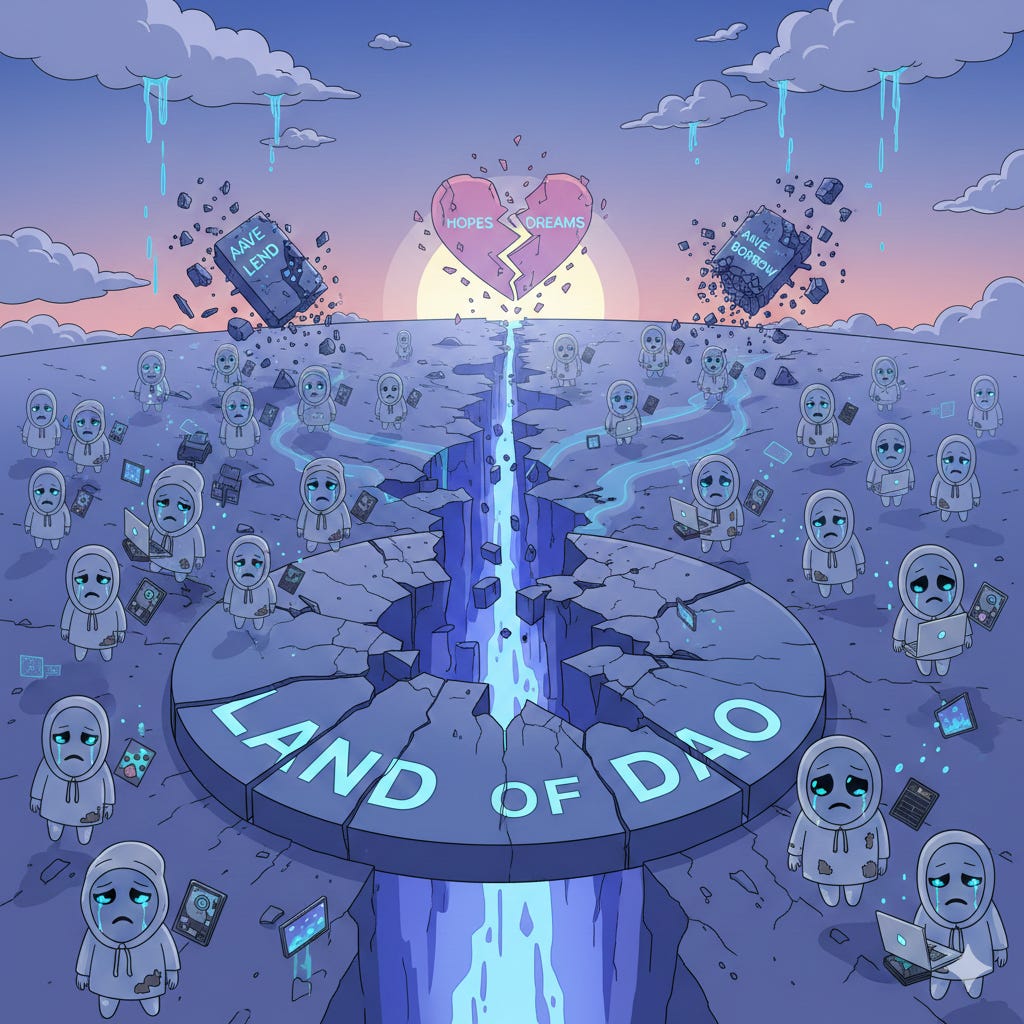
Let’s start with Aave, the biggest lending protocol in DeFi, sitting on top of $26 billion in user deposits. For a long time, Aave was the poster child for how a DAO could actually work. Token holders voted on things. Proposals got debated. An independent contractor, not the founding company, did most of the heavy lifting on the code. It felt, almost, like the thing was supposed to work.
Aave is a borrowing and lending platform where you can deposit crypto to earn interest, or put up crypto as collateral to borrow other crypto, all without a bank or any middleman involved.
That contractor was Bored Ghosts Developing (BGD), who’ve spent the last four years building basically everything users interact with inside the Aave v3 product: the risk parameters, the technical infrastructure, the bits that quietly stopped the protocol from blowing up more than once. Unglamorous, dev work and vitally important work.
Last Friday, they announced they won’t be renewing their contract in April.
The reason? Aave Labs, the founding company run by Stani Kulechov, wants to push everyone toward a new version of the protocol, dubbed v4. BGD think this is premature at best, and “borderline outrageous” at worst, given that v3 is the thing actually generating the revenue and has done nothing wrong except exist while Labs chases the new shiny thing.
One prominent DAO delegate called BGD’s departure “devastating.” That feels right. These were the people whose code kept the lights on.
Here’s what’s interesting about the power dynamics, though. On paper, the DAO controls Aave. Token holders vote. Labs is just another service provider. But recent votes have suggested Kulechov and Labs retain enough voting weight to consistently outvote the opposition when it counts. They lost the brand vote, just barely, on Christmas Day, of all days to hold a governance vote. The timing wasn’t subtle.
So what you actually have is a protocol that looks community-governed, but where the founding entity still holds enough sway to steer things the way it wants, and where the people doing the unglamorous technical work have finally decided it’s not worth the politics.
BGD’s farewell post on the governance forum is worth reading in full if you want a masterclass in professional disappointment. They’re asking for a two-month transition retainer and helping find a replacement. Dignified exit. Burning bridge, nonetheless.
Kulechov has said Labs will pick up the v3 maintenance work. Maybe they will. But there’s a difference between a founder volunteering to do something and an independent team that’s spent four years thinking of nothing else. The market noticed. AAVE dropped more than 6% on the day.
The broader question here isn’t really about Aave specifically. It’s about whether DAOs can maintain genuinely independent technical contributors once a founding company gets ambitious again. The answer, at least this week, appears to be: not indefinitely.
Base and the Polite Breakup That Wasn’t
Meanwhile, over in L2 land, something arguably more structurally significant happened.
Base, Coinbase’s layer-2 network and the busiest chain in Ethereum’s rollup ecosystem with $3.85 billion locked in it, announced on February 18th that it’s ditching the Optimism OP Stack and building its own unified codebase. It called the move a technical decision: faster upgrades, less coordination overhead, all their infrastructure under one roof. Totally reasonable framing.
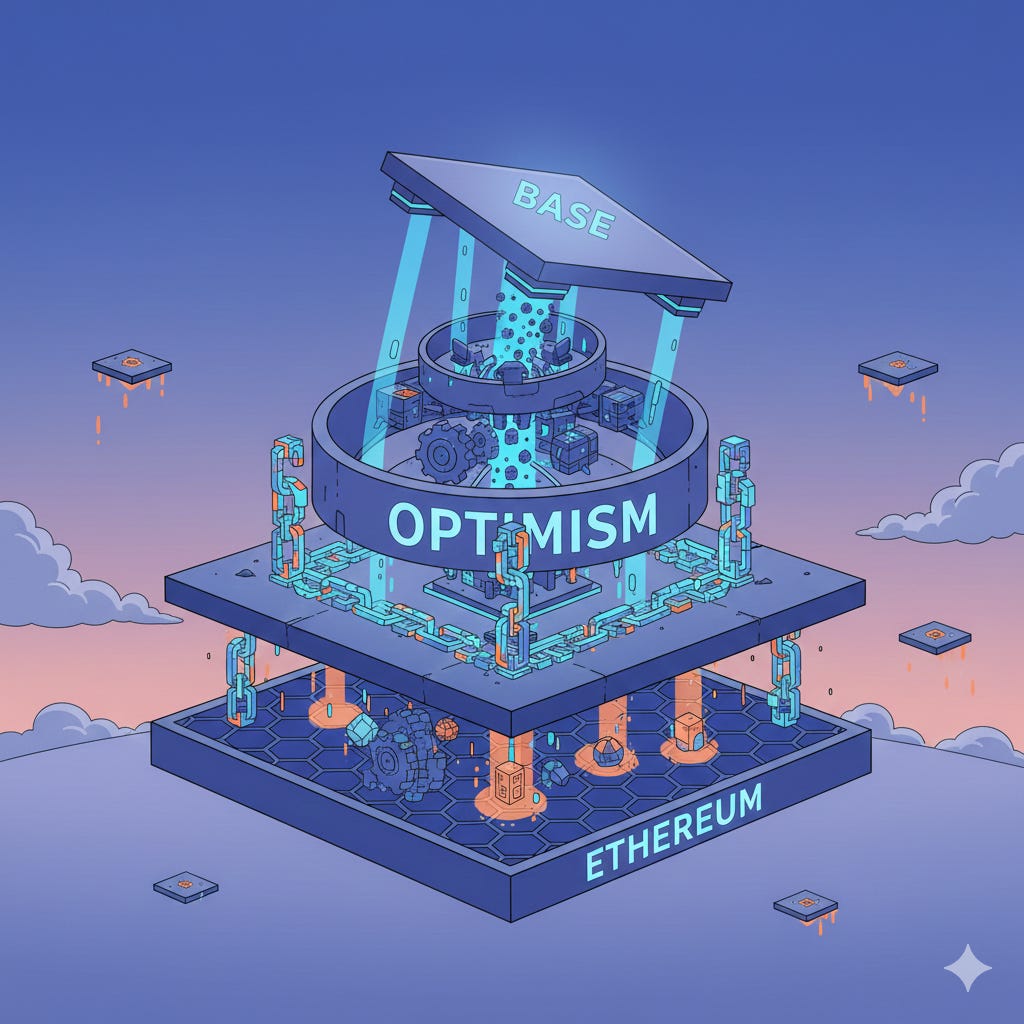
Ethereum is the main network, but it gets congested and expensive fast.
Optimism is a rollup, meaning it processes transactions on a separate, cheaper chain and then bundles them up and posts a summary back to Ethereum to keep the security guarantees.
Think of Ethereum as the court of record and Optimism as the office that does all the paperwork before filing it.
BASE is then built on top of Optimism’s roll-up technology, the OP Stack, doing the same thing but run by Coinbase.
So you have three layers: Ethereum settling everything at the bottom, Optimism’s infrastructure in the middle, and Base using that infrastructure to run its own cheaper, faster chain on top.
The market didn’t buy the neutral framing. Optimism’s OP token fell somewhere between 14% and 26% depending on when you checked. That’s not a “we’re just tidying up our code” reaction, that’s a “oh no, where will the revenue come from” reation.
To understand why, you need to understand the Superchain model, which is the big idea Optimism has been building toward.
The pitch is that chains build on the OP Stack, they benefit from shared technology and interoperability, and in exchange they contribute a small slice of their fees back to the Optimism Collective, either 2.5% of chain revenue or 15% of profits, whichever is higher. A rising tide lifts all boats, and Optimism gets paid for building the boats.
The problem is BASE was almost the entire tide and reports suggest BASE was contributing somewhere around 90% of the Superchain’s total revenue. It was generating roughly four times more transactions than Optimism itself, 144 times more DEX volume, and 80 times more gas fees.
Optimism’s entire token buyback programme, which the Collective had only just approved in January using 50% of incoming Superchain revenue, was predicated on that revenue continuing to flow.
And now it isn’t.
BASE says it will remain an “OP Enterprise customer” and keep compatibility during the transition.
This is the crypto equivalent of telling your ex you still want to be friends.
Maybe true. Maybe not.
Also somewhat irrelevant to the revenue question.
What makes this genuinely interesting rather than just gossip is the open-source licensing problem it reveals. The OP Stack is permissively licensed, meaning anyone can use and fork it freely.
That’s philosophically generous, and commercially fragile.
Optimism couldn’t stop BASE from doing this even if it wanted to. The whole Superchain revenue model depended on partners choosing to pay in, not being contractually required to. When the biggest partner generates enough activity to want its own stack, the incentive to keep paying a “Superchain tax” collapses.
As one analyst put it: if BASE is leaving, why would anyone else stay and share revenue?
There’s also a rumour worth mentioning, because it reframes the whole thing slightly.
Speculation is circulating that Coinbase is planning a BASE token launch later in 2026. If true, you’d want your own codebase for that. You’d want to control your sequencer revenue directly rather than watching a chunk of it flow to someone else’s collective.
Coinbase hasn’t confirmed anything. But the timing of this “technical independence” move would make an awful lot of sense if that’s where this is heading.
What These Two Stories Have in Common
At first glance, Aave and Base/Optimism look like different kinds of problems. While one is a governance fight and the other is an ecosystem breakup, they’re both pointing at the same underlying tension.
Both stories are about what happens when decentralisation meets institutional ambition.
Aave built a genuinely functional DAO, then its founding company decided the direction of the protocol mattered more than the autonomy of contributors.
Optimism built a genuinely collaborative network, then its biggest member decided independence mattered more than the collective.
In both cases, the “decentralised” structure held, technically. The DAO still exists. The OP Stack is still open-source. But the thing that made them feel meaningfully different from just a company making decisions has taken a hit.
This isn’t cynicism, or at least I’m trying not to let it be. DAOs are a genuinely interesting experiment in how to coordinate open systems without traditional corporate hierarchy. The fact that they’re hard, and that they fail in specific and instructive ways, is part of how we learn what works.
BGD leaving Aave is useful information. Base leaving Optimism’s revenue model is useful information.
The useful information is roughly: incentive alignment is everything, and it erodes.
Founders retain more power than governance documents suggest. Open-source licensing without economic alignment doesn’t create a community. It creates a resource that gets consumed. When the biggest contributor’s interests diverge from the collective’s, the collective loses.
None of that means the whole project of decentralised governance is doomed. It means the specific implementations we’ve built so far are showing their seams. Aave might come out the other side with better governance structures. Optimism might evolve its model in ways that don’t depend on one chain providing nearly all the revenue.
Or they might not. Worth watching either way.
That’s it for this week. As ever, not financial advice, just someone who’s been watching this stuff long enough to find the politics more interesting than the price. 😉